By Asia Simms, Northeast-Midwest Institute Intern and Northeastern University Graduate
There is only one grain native to the Great Lakes region. It’s not millet, sorghum, or rye. Wheat came from the fertile crescent. Corn, despite its now ubiquitous presence in the American Midwest, was first cultivated in what is now southwest Mexico. Instead, it’s wild rice, Zizania palustris and Zizania aquatica, or, as it’s known in the Anishinaabe tribes, manoomin. According to Anishinaabeg oral tradition, their people originally lived on the Atlantic coast, but when they were given a prophecy to find “the place where food grows on water,” they migrated westward. Eventually, they came upon lakes filled with stalks of rice, which was a reliable and delicious food source to supplement meat and fish. As Dr. Robin Wall Kimmerer explains in her book The Serviceberry, the suffix of the word,“min,” is “the root for ‘berry’” in the Potawatomi language, and appears in multiple Potawatomi words, including “Blueberry (Minaan), Strawberry (Odemin), Raspberry (Mishiimin), Maize (Mandamin), and Wild Rice (Manoomin).” The direct translation of the word manoomin is “the good berry.” In Dakota, it is “Psíŋ.” Located in Minnesota and Wisconsin, the Dakota tribes have lived for centuries along the region’s lakes and rivers, all the while harvesting wild rice.
Manoomin has taken care of the region, and in return, the people who live there treat it with mutual respect. “Once you start working with manoomin,” Darren Vogt with the 1854 Treaty Authority said in an interview, “It becomes part of who you are.”
There is a special way to harvest and prepare this grain. Manoomin is gathered by a team via canoe, with one poler and one harvester. Michaa Aubid is an experienced poler and a member of the Anishinaabe in northern Minnesota. In an interview with PBS he said that a poler’s job is to “cut through the bed [of rice]… creating as minimal of disturbance as we can and getting it to where than manoomin hangs just over the boat just right for the picker to be able to not have to work too hard to tip it in.” The harvester gently guides the rice into the bottom of the canoe by tapping it with the ricing sticks. Veronica Skinaway, the second part of Aubid’s ricing team, described her job as a “gentle tapping” like “a heartbeat” that collects the ripened manoomin.
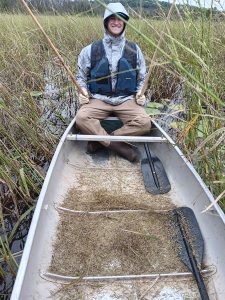
Manoomin harvested with ricing sticks in the bottom of a canoe
Image courtesy of Matthew Steiger, Wisconsin Department of Natural Resources
Manoomin is also an incredibly healthy grain. According to the USDA’s National Nutrition Database, manoomin has 50% more amino acid content as compared to a grain like white rice, and 25% more protein and 30% fewer carbs than long-grain brown rice. It is heart healthy and is delicious in a variety of recipes, including one for venison casserole published by the Great Lakes Indian Fish and Wildlife Commission’s Mazina’igan newsletter.
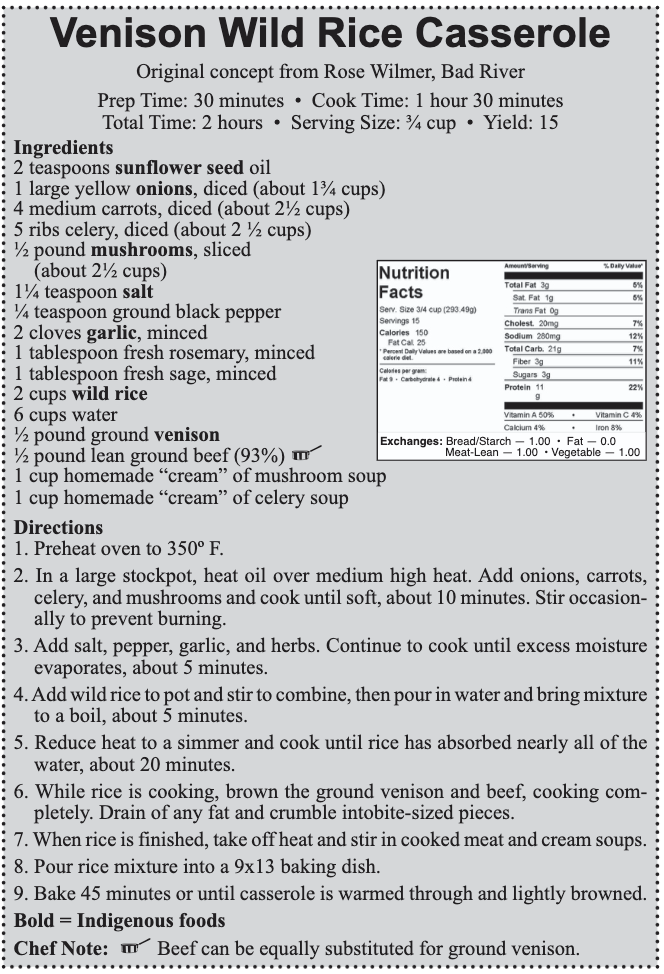
From Mazina’igan: A Chronicle of the Lake Superior Ojibwe, Fall 2016 edition
Wild rice has been shared and appreciated on a much wider scale through the James Beard Award-winning restaurant Owamni, founded by “The Sioux Chef” Sean Sherman, a member of the Oglala Lakota Sioux tribe. Owamni is a full-service Indigenous restaurant created to showcase North American Indigenous food and culture, and share Indigenous products developed by Native food producers. Many recipes feature wild rice. Sherman’s restaurant has been so successful that it will move to a new location later this year to expand their dining space.
But this popular, healthy, and versatile food faces threats. Over the past two hundred years, habitat loss, damming, pollution, climate change and other factors have caused rice populations to dwindle to the point of near extinction.
Risks and Threats to Manoomin Populations
Manoomin has very specific requirements for healthy and successful growth. Like other kinds of rice, it needs plenty of water to survive, but manoomin specifically needs the presence of slow flowing water, like rivers or lakes, that have an inlet and outlet. The ideal waterway should be clear, since murky water limits sunlight.
Environmental stressors resulting from climate change pose a considerable challenge for manoomin restoration and stewardship across the species’ range. “The number one concern is climate in general. Everything is kind of interrelated – storm events create higher water levels, if there’s elevated water levels during floating leaf stage that’s bad,” Vogt reflected in an interview. “There has been a change in growing season, we’re having less ice coverage, earlier ice off in the spring, later ice up in the winter. There’s more competing vegetation, and we don’t quite know yet what is causing those species to thrive. Higher humidity is causing brown fungal spots, and there is an increase in geese and swan populations that are eating the plants.”
Manoomin can handle several types of riverbed composition if other growing conditions are good, including sandy and semi-rocky substrates, but several inches of soft organic muck will yield best results. The St. Louis River that flows through Minnesota and Wisconsin and into Lake Superior is a fantastic example of a prime ecosystem for the rice. Historically, it had one of the most abundant concentrations of the plant in the Great Lakes region. Up until the 1960’s, there were between 600 and 1,000 acres of rice growing on the riverbanks.
However, the St. Louis River has been hindered by the consequences of historic industrial activity, with pollution, logging, dredging and filling being the most significant. “Wild rice was essentially lost,” Vogt commented. Before the adoption of modern pollution laws, sediments became heavily contaminated with mercury, dioxins, polychlorinated biphenyls (PCBs), polycyclic aromatic hydrocarbons (PAHs) and other toxins. In the modern day, these contaminants have resulted in beneficial use impairments (BUIs). BUIs are designations created by the International Joint Commission that represent different types of significant environmental degradation. As cleanup work is completed, and monitoring demonstrates sufficient environmental health improvements, BUIs can gradually be removed. The St. Louis River Estuary currently has five remaining BUIs, including “Restrictions on Dredging Activities,” which is in place because of the contaminated sediment.
Manoomin’s unique life cycle also makes it vulnerable. Plants germinate and produce leaves underwater, and then go aerial later in their development.
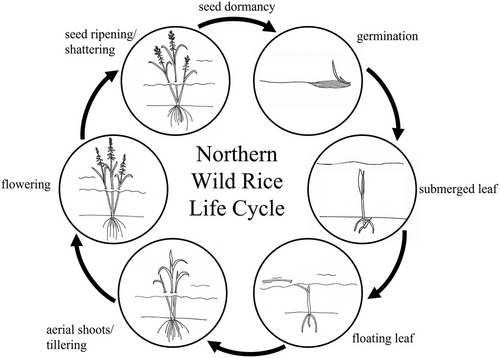
Lifecycle of Manoomin
Water quality is the most significant concern in the germination stage of the plant, but in the floating leaf and early aerial emergent stages, one of the biggest documented threats is herbivory by Canada geese. “When we were trying to establish manoomin, it seems that wild geese, manoomin seems to be a species that they select for,” Steiger reflected in an interview. “They have natural phenology that matches up with the life stages of the rice. The geese molt and become flightless right as the rice comes out of the water. I think there’s some adaptations there that the geese have developed since this is a wonderful nutritious food source. It was like putting out a buffet, and we really experienced 100% loss in one of our sites. We would see germination, floating leaf stage, and as soon as they started to come out of the water was when those goose families just knew it and just stayed there and went after it.”
This stage in the rice’s lifecycle coincides with the molting of goose flight feathers before migration. In early June, when the geese are flightless, they take full advantage of the nutritious food to fuel up for their migration. The impact of these birds is so severe, in fact, that the Wisconsin DNR has tried countless techniques to combat them. “We attempted several nonlethal methods of trying to reduce that herbivory pressures, and we did not see a significant reduction in herbivory until we were able to reduce the goose population. That involved getting approvals and permits from state, local and federal authorities and assisting the City of Duluth in writing a goose management plan,” Matthew Steiger from the Wisconsin Department of Natural Resources reflected in an interview. He shared that since 2021, five goose roundups have been conducted, resulting in nearly 1,600 geese removed near core restoration sites. The addition of yearly roundups to the non-lethal herbivory management have increased rice populations in implementation sites, such as the Allouez Bay in the St. Louis River Estuary, Steiger shared in a 2025 report.
The images below show exclosure efforts taken by many partners including the 1854 Treaty Authority, an Inter-Tribal natural resource program “dedicated to ensuring the rights secured to member Indian tribes by treaties of the United States to hunt, fish and gather within the 1854 Ceded Territory.” One of their areas of focus is manoomin, and they have taken steps to deter herbivory by Canada geese. The images below show the effects of putting up fencing around the crop, which has kept geese – flightless during molting – from destroying floating leaves. The picture on the right shows a close-up shot of the fencing, and the rice inside is thick and abundant. In the more zoomed out perspective on the right, it is clear that rice is only growing in the exclosures. It is clear that the goose exclosures are needed; there is almost no rice growth outside, where the plant remains vulnerable.
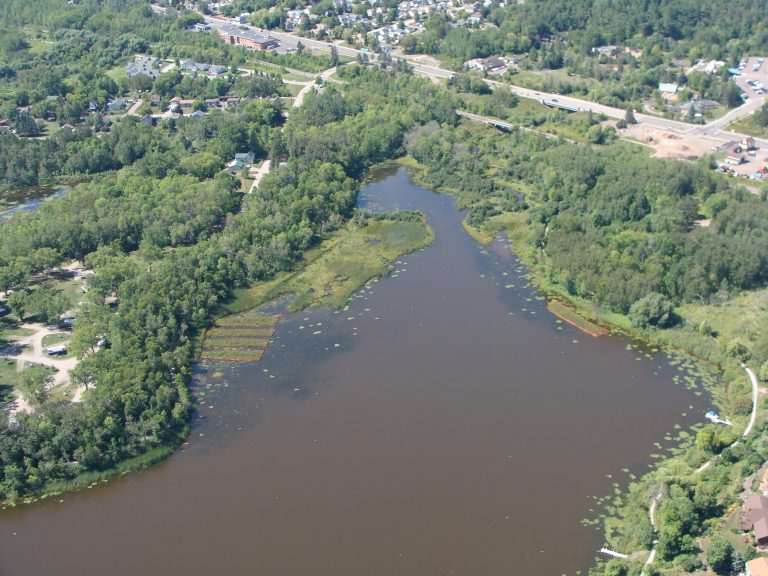
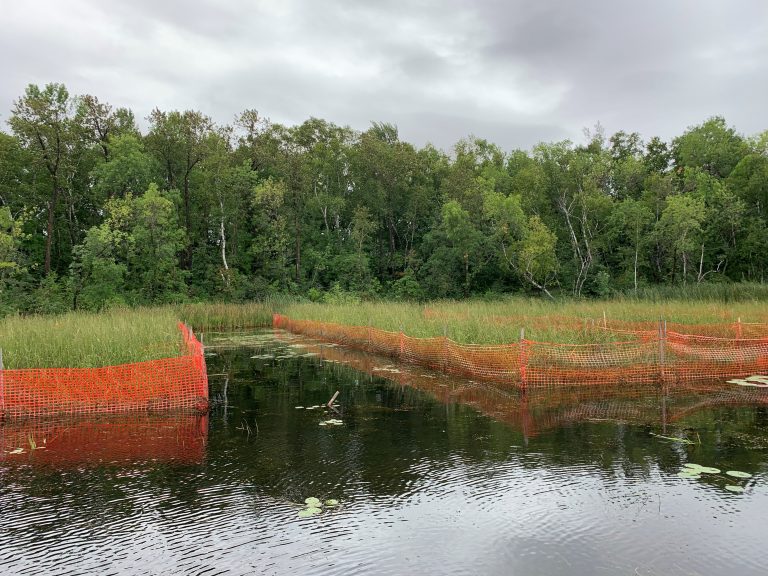
Kingsbury Bay restoration initiative in the St. Louis River estuary, 2023
Images courtesy of Darren Vogt, 1854 Treaty Authority
Why Manoomin Should Be Protected
Wild rice is considered an important keystone species in the ecology of the St. Louis River because of the ecosystem services it provides. Manoomin has also been termed a “cultural keystone species,” a term coined in 2004 by Ann Garibaldi and Nancy Turner at the University of Victoria to describe “plants and animals that form the contextual underpinnings of a culture, as reflected in their fundamental roles in diet, as materials, or in medicine.” “It’s an important resource, and also an important part of Ojibwe culture,” said Vogt, “We’re really interested in preserving the harvesting rights themselves, and also the resources and that strong cultural tie. Anything we can do to protect that is high on our radar.”
Steiner concurs. “If I had to put one word to it, I’d say it’s an indicator,” he said. “It’s an indicator of the health of the people, the Ashinaabe people. It’s part of the identity of some of the tribal members and losing that connection would be a loss that most people can’t grasp. It’s also an indicator of the health of the ecosystem, and the health of the animals that rely on manoomin.” Manoomin provides food and habitat to a variety of fish and wildlife species throughout its growth cycle, and is especially important in its role for conservation of bird species. Manoomin provides important habitat for many marsh breeding birds that take advantage of open water availability, cover, and food resources. A portion of the manoomin seed produced during the growing season will replenish the seedbank while residual seed becomes available as food for mallards, wood ducks, American black ducks, northern pintails, blue-winged teals, canvasbacks, and other waterfowl species.
Fish species such as northern pike lay eggs on the submerged rice in the spring, while mature aerial rice stalks 10.1577/1548-8675(2001)021%3C0046:COHLDO%3E2.0.CO;2">provide habitat for fish seeking to avoid predators. Muskrats have a mutually beneficial relationship with the rice. They forage on the rice stalks and other aquatic vegetation, and in doing so create a 50:50 mix of open water and mixed emergent and aquatic vegetation, known as open-water hemi-marsh conditions. These conditions are incredibly productive for seed-producing plants such as manoomin, and have the added benefit of attracting marsh birds like the sora.
Manoomin also beautifies the environment and supports recreation. Steiger said that “there’s nothing quite like it, being out in the rice bed. When you’re out there, you get to see the bumblebees, you get to see the birds migrating through to find the seed, the muskrats using it as housing, the fish that eat the worms when you knock them off. There was an ecosystem that was just missing, it adds such an important factor to the wetlands.”
Without rice supporting the region, there would be fewer fishing and birdwatching opportunities, and regions like the St. Louis River Estuary would lose what makes them special.
Conservation Efforts Now
Many of the current conservation efforts happen within state Departments of Natural Resources. The Michigan DNR helps tribes across the Midwest work together to share seeds that are being ethically and naturally sourced, and gain access to the waterways that support them.
Minnesota has more acres of naturally growing manoomin than any other state in the region. Wild rice has been historically documented in more than half of Minnesota’s counties and in over about 2,400 waters. Minnesota’s DNR is helping to lead habitat restoration projects in the St. Louis River Estuary intended to increase the diversity and area of wetlands and restore aquatic vegetation. In partnership with Wisconsin’s DNR, MNDNR, tribes, and other partners are part of the St. Louis River Estuary Manoomin Restoration and Stewardship Plan, an effort funded by the Great Lakes Restoration Initiative. This plan maps out comprehensive wild rice restoration initiatives over the next 20 years, including the removal of BUIs.
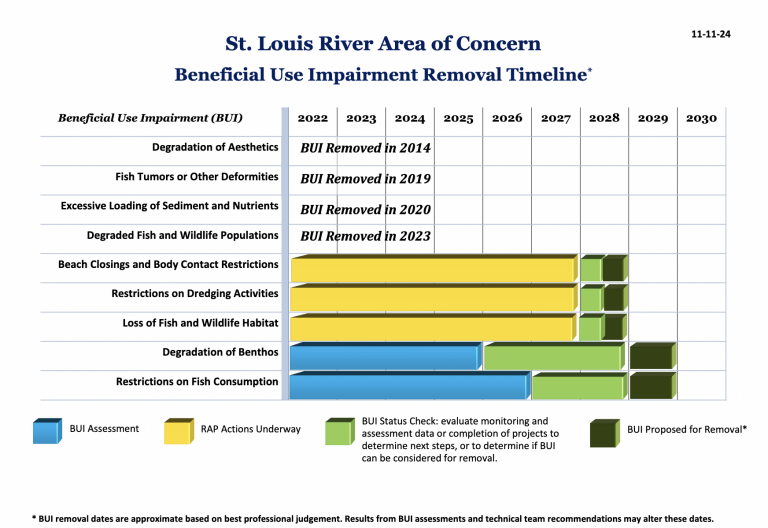
BUI Removal Timeline, Wisconsin DNR
Organizations like the 1854 Treaty Authority partner with tribes to manage resources and enforce conservation for manoomin, among other species in the Great Lakes region. “When it comes to the St. Louis River, that’s historically and culturally an important place, a part of the Ojibwe ceded territories,” Vogt said about the importance of the Treaty Authority’s work, “Over the last 20 years the cleanup sites have been improved, all the partnerships have been doing a great job cleaning up that resource. It’s been a big change here from how it used to be in the estuary, when fish populations were unsafe to eat and there really was no rice.” Part of the Treaty Authority’s role is to keep a database inventory of wild rice in the ceded territory. They conduct in-depth survey monitoring in ten lakes to keep track of rice populations and provide wild rice condition updates each year for harvesters.
None of this restoration work would be possible without the work of the Fond du Lac Band of Lake Superior Chippewa. In 2015, they provided 8,500 pounds of rice to jump-start the restoration program. They planted these seeds in five different bays along the St. Louis River Estuary, and cut back some of the existing vegetation to help manoomin to get a foothold in restored areas.

Members of the Fond Du Lac Band of Lake Superior Chippewa seeding the St. Louis River in 2019
Image courtesy of Matthew Steiger, Wisconsin Department of Natural Resources
Research and Cultivated Wild Rice
Scientists across the region are also studying a cultivated version of wild rice. Cultivated rice is different from wild rice in the way it is grown and harvested. “We grow a cultivated wild rice in these paddy systems that have raised dikes… and are flooded with water,” Dr. Kimball of the University of Minnesota explained in a video posted on her lab’s YouTube page. To flood the paddies, they installed an “irrigation line that we use to pump water… from the Prairie River.” Instead of a poler and a ricer, rice crops grown in paddies are typically harvested by “mechanical harvesters, also known as combines.”
Studies are usually focused on the plant’s lifecycle, how the plants reproduce, and research attempting to help with resilience against diseases like 10.3389/fpls.2024.1350281/full">fungal brown spot. This disease creates purple and brown spots on the leaves that kill plant tissue. The Kimball Lab at the University of Minnesota runs one such program that grows, studies, and selects for specific traits in cultivated rice. “To my knowledge,” Kimball said, “my group is the only academic lab that researches rice 100% of the time, so we try to do a lot with what we have.” Kimball’s lab has published papers on fungal brown spot, gene flow, pollen travel, and other topics regarding cultivated rice in papers dating back to 2019. Wild rice also faces unique threats. “From my point of view, boating, recreation, and people building homes on our lakes, that’s the biggest threat to wild rice populations,” she said in an interview. “Climate change is the second biggest, but pretty immediately I think we need some laws on the books to protect the rice populations from that.”
Even in paddies, cultivated rice creates an environment that fosters life. “I have been of the mindset to call it a keystone species because it is so important in its habitat. It provides food and shelter for so many species, I mean we’re talking the whole chain. We’ve got moose eating the seed, invertebrates in the water using it for shelter and for mating, we have water fowl like Sora that use the habitat for its nesting ground. I think I breed something like 10,000 frogs in my rice paddies each year,” Kimball said. “And it is also so important to the Indigenous people here. It’s my understanding that when wild rice does well, everyone and everything that relies on it is doing well, too.”
One of Dr. Kimball’s goals is to help harvesters of cultivated rice she works with have a better yield. “Red Lake Nation is a grower of cultivated wild rice, and I work with them pretty frequently,” Kimball said in an interview. “We did a roundtable a couple months ago, but we’re still really trying to understand what consultation looks like with Indigenous folks.”
Looking to the Future
Building a future for manoomin requires a long-term commitment. “Restoration ‘lite’ doesn’t work in this situation,” said Steiger, a partner on the St. Louis River Estuary Manoomin Restoration and Stewardship Plan. After over a decade of work, he says that “we’re seeing rice show up in places we never seeded, they were either resting and waiting for the right opportunity, or they were transported.”
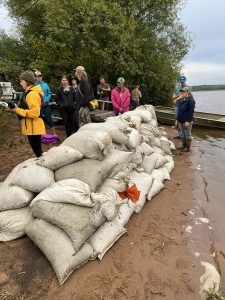
3,200 pounds of manoomin harvested from the Allouez Bay in 2025
Image courtesy of Matthew Steiger, Wisconsin Department of Natural Resources
Vogt shares a similar story. “With all the clean-up in the St. Louis estuary, our partners have seeded 96,000 pounds of wild rice since 2015,” he shared. “In the last three years alone we have seen a lot of wild rice come back to the estuary.”
Continued restoration will not be without challenges, but this coalition of partners has set North America’s only native grain on a clear path to recovery. With any luck, manoomin will sustain birds, fish, and humans for generations to come. “It’s been really fulfilling to see it find its place again,” Vogt said.