By Taylor deNeve, Northeast-Midwest Institute Intern and Student at Texas A&M University
The Maumee AOC is an interconnected system spanning 787 square miles and 11 independent watersheds, each one contributing differently to the overall condition of the AOC. “We are the third-largest U.S. AOC,” explains Cherie Blair, the Maumee AOC Coordinator and Grant Manager at the Ohio Environmental Protection Agency. “We can hold 21 of the 26 U.S. AOCs within our boundary.” This vastness inherently changes how restoration works, where distributed and simultaneous action is required across multiple waterways rather than a point source approach. The result is restoration channeled through more than 80 management actions, including sediment remediation, habitat restoration, and fish and wildlife recovery. Each project becomes a different piece within the expansive Maumee AOC puzzle. Yet despite the challenge presented by its massive scale, the Maumee AOC is one of the most active restoration zones within the Great Lakes region.
Contamination in Context
The Maumee AOC’s environmental challenges are intertwined with the historical land use in its home of Northwest Ohio. For generations, the region has been one of the most productive agricultural corridors in the United States, feeding into multiple river systems that flow into Lake Erie. However, persistent ecological tradeoffs have been a consequence of that productivity. Nutrient runoff, sediment loading, and legacy industrial sites have all combined to degrade water quality decade after decade.
Specific contaminants include polychlorinated biphenyls (PCBs), polycyclic aromatic hydrocarbons (PAHs), and other heavy metals which contribute to serious health and ecosystem risks. In the Ottawa River, which is located in the AOC, the high levels of PCBs and other contaminants ultimately resulted in a no-contact advisory from 1991-2018.
By the time the Maumee was listed as an Area of Concern in 1987, environmental conditions had deteriorated to the point where multiple beneficial uses of the area were severely impacted. Habitats were degraded and physically eroded, fish populations became stressed and suffered deformities, and sediment became contaminated. The AOC’s designation wasn’t the result of a single point or source of failure, but a system that had undergone persistent pressures that accumulated over the years and across multiple watersheds. The key to restoration, then, becomes the management of many smaller variables across hundreds of square miles.
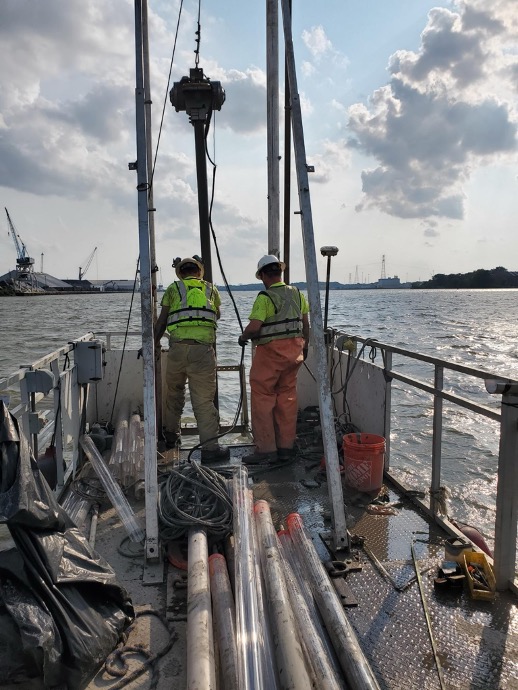
Fig. 1 Sediment sampling in Maumee River
Photo Credit: U.S. Army Corps of Engineers
Leah Medley, the Task Force Lead for the Maumee AOC at the Environmental Protection Agency, explained how addressing the scope of the problem requires a shift in perspective. “The Maumee River part of the Maumee AOC is only 4% of the total Maumee River watershed,” she notes. Water, sediment, or nutrient runoff does not remain purely within the designated boundary, and contamination from elsewhere in the watershed can be tricky to combat. “It’s difficult for us to do the work that we need to do within the AOC, to address sources within the AOC, which is all that we can do, when we have so much coming from outside the AOC that also impacts that,” Medley said.
Meandering Complexities
The Great Lakes Water Quality Agreement (GLWQA) established 14 Beneficial Use Impairments (BUIs) that must be remediated in order to delist an AOC. The impairments stem from a reduction in the chemical, physical, or biological integrity of the waters. Of the 14 possible BUIs, the Maumee AOC had ten identified. Four have been removed, which speaks to the challenge of remediating a site as large as the Maumee AOC. Blair has witnessed the AOC’s complexity and development over her 34-year career. “Most AOCs would be a single river and the tributaries coming into that river. The Maumee is very different because the Ottawa River goes straight to Maumee Bay, and all these tributaries over here [in the AOC] go straight to Lake Erie. They don’t connect to each other, so they have to all be addressed independently.”
She expands that in the Maumee AOC, with its 80+ Management Action Projects including multiple contaminated sediment projects and separate sub watersheds, an action in one area of the AOC may not directly improve another area miles away. This presents a unique challenge, but progress is being made. “We have removed four of the ten BUIs we had, and of the six that remain, four of those are tied directly to biological projects we’re currently working on,” Blair said. “Over 50% of the projects currently being worked on will be completed by the end of 2026.”
And great success has been seen in recent years. In August 2025, the Maumee AOC completed all designated Wildlife Management Action Projects (WildMAPs). Over the past 7 years, $27 million has been invested into restoring over 3,500 acres of wildlife habitats and addressing the key ecological issues faced in the Maumee River and nearby watersheds. This achievement, which directly targeted BUI 14b (Loss of Wildlife Habitat), built on a decade of strategic effort coordinated by the Maumee AOC Advisory Committee (MAAC) and over 30 regional stakeholders. Habitat restoration projects for wetlands, prairies, and forests have improved the region’s health, and have gone a long way towards addressing the final six BUIs and future delisting of the AOC through continued work on Aquatic and Sediment MAPs.
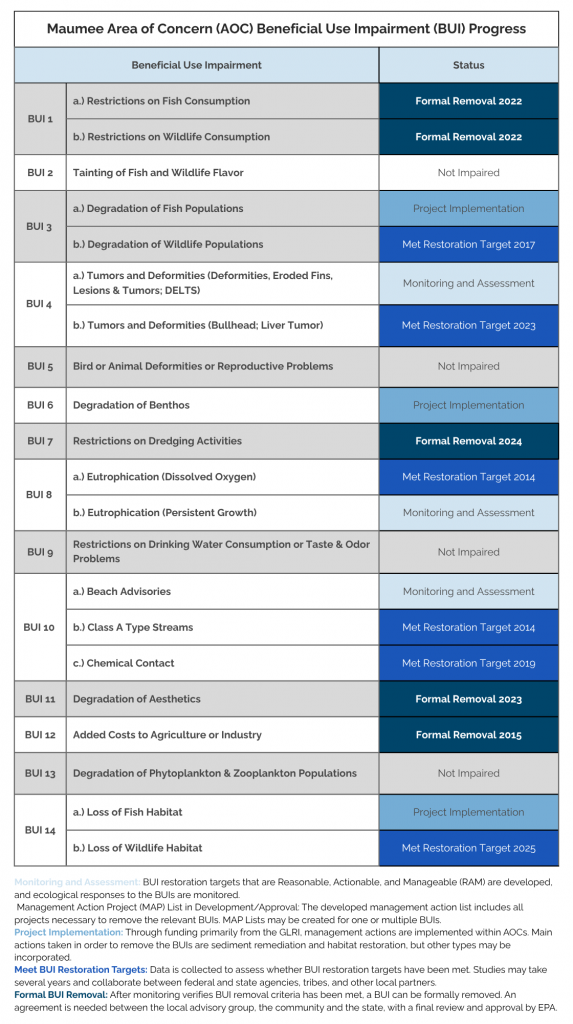
Fig. 2: Original and remaining Beneficial Use Impairments for the Maumee AOC
*Remaining as of February 2026
Source: Maumee AOC Data Management & Delisting System, Lake Erie Commission
Contaminated sediment, which is often the result of legacy pollution from industrial sources, remains one of the most expensive and logistically difficult aspects of delisting the AOC.
Kate Mattson, the Maumee AOC Sediment Project Manager at EPA Region 5, describes the structural barrier. “[A] Cost-sharing partnership is required for all sediment remediation work. There’s a minimum 35% nonfederal cost-share… coming up with the nonfederal cost-share partnership is a main barrier for completing all of the potential sediment remediation work.” Even when federal funding is available, projects are unable to move forward without contributions from their partners. While this distributes responsibility and cost burden, the requirement can slow implementation timelines.
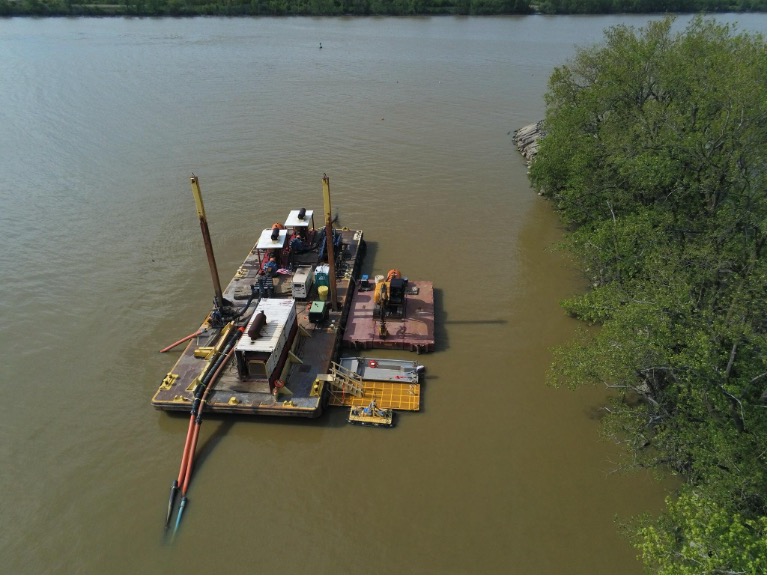
Fig. 3 Pumping system in Otter Creek to move contaminated sediment to a Confined Disposal Facility.
Photo Credit: U.S. Army Corps of Engineers
Sediment remediation projects also vary widely in cost, ranging from several million to tens of millions of dollars per site depending on contamination levels and engineering requirements. Blair elaborates, “Sediment cleanup projects are always expensive… Removal of the contaminated sediment behind the Gorge Dam in Cleveland is over a $100 million project, compared to other sediment projects that might be only $7 million. So, they’re going to range.”
⼮
WE’VE SEEN GREAT SUCCESSES WITH THE RESTORATION OF THE MAUMEE AOC, BUT WHAT SHOULD BE KEPT IN MIND AS WE MOVE TOWARDS DELISTING THE AOC?
Cherie Blair, Maumee AOC Coordinator and AOC Grant Manager at the Ohio EPA:
“Don't forget all the work that's been done. You got to know where you came from to know how far you've gotten and then how far you have left to go. There are new challenges, PFAS or HABs. We didn't deal with that in the early years of the AOC Program because it wasn't a thing. Those are the challenges that remain for the future. But, again, acknowledging where you've come from, taking note of where you are and the progress you've made, as you look toward what remains to get you where you're going.”
Leah Medley, Task Force Lead for the Maumee AOC at the EPA:
“It is still going to depend on the work that is left to be completed… Some of those [Beneficial Use Impairments] take time to respond to the work that's been completed. So, there might be a lot of time between completing everything and then seeing a response in the environmental indicators that tell us that we've made the impact that we were expecting to make.”
Eric Saas, Program Manager at H2Ohio Wetlands Program:
“We have to be cognizant of the fact that delisting is a very important milestone and a very noble, good goal that I hope we are going to achieve here in the near future. But that does not mean that we plant the flag and say “Okay fine. All the work is done here.” … There's going to be an element of making sure that we're sustaining progress and continuing to enhance that area, that portion of the watershed for all of the benefits that nature and people and Lake Erie will derive.”
Dr. Bill Hintz, Faculty at University of Toledo Lake Erie Center:
“Great progress has been made. I think there are still multiple issues to work through. I think delisting an AOC is a good goal, but I also think you need careful metrics in the delisting of an Area of Concern. There are the historical metrics that you can use, but sometimes you have to stop and ask yourself, ‘Have we captured the current issues as well?’ I really think that the delisting process should involve all vested parties, and we should think through some of these emerging Contaminants of Concern [PFAS, microplastics] when we start to delist the AOC.”
⼮
All Hands on Deck
In the Maumee AOC, the path to delisting is made up of remediation and restoration efforts. Remediation is the process of stopping, reducing, or removing pollution that threatens the health of fish and wildlife or people. Restoration aims to enhance, rebuild, or create habitats to restore ecological function.
Management Action Project Progress
Despite the considerable challenges, the Maumee AOC has made substantial strides. 28 out of 55, or 51%, of identified Aquatic Management Action Projects (AquaMAPs) have been completed. These AquaMAPs focus on what will remove the aquatic-based BUIs such as: Degradation of Fish Populations, Degradation of Benthos, and Loss of Fish Habitat. “We have funded everything that needs to be completed for restoration projects which is really exciting,” says Medley of habitat projects. “There’s still projects left to get into implementation … This is the culmination of years and years and years worth of work, and it’s not just us but all of our partners and the leveraging that’s gone into it.”
Blair also reflected on this significant progress, noting the funding that has backed it. “We have over $35 million dollars in projects currently in progress with more than $110 million dollars that have been funded since 2018.”
The H2Ohio Program, a water quality initiative initiated by Ohio Governor Mike DeWine, has also played an important role in restoration. Eric Saas, the Program Manager for their Wetlands Program, notes how the projects already undertaken have informed future ones. “We have empirical evidence that our project work is doing what it’s supposed to be doing, and we can manage our existing projects and our future projects based on what we’re learning on the ground.”
Removal of Restrictions on Dredging Activities
In September 2024, the Maumee Area of Concern and surrounding waterways made progress towards its restoration goals after meeting all the criteria to formally remove the Restrictions on Dredging Activities BUI. After the U.S. EPA Great Lakes National Program Office (GLNPO) approved the request, this became the fourth BUI removed and moved the Maumee AOC closer to delisting. The Toledo Shipping Channel is the most heavily dredged in the Great Lakes and the beneficial reuse of this sediment has contributed to multiple projects such as tree growth in Toledo’s Glass Metropark and research at Bowling Green State University. These results and improvements are a direct result of the collaboration between federal agencies, state, and local partners. Medley says that success stems from having a great team of people working with their partners, “every step of the way to get things done at the AOC.”
Clark and Delaware/Horseshoe Islands
The restoration of Clark and Delaware/Horseshoe Islands in the Maumee River represents one of many targeted efforts to address the Maumee AOC’s biggest challenges: contaminated sediment and the flow of nutrient pollution into Lake Erie. H2Ohio funded $8.7 million for restoration efforts alongside $5.9 million from the GLRI that would address the erosion that had degraded the islands’ structures. The rock and natural structure installations created conditions where sediment could be captured, allowing it to settle rather than traveling further into Lake Erie. On top of the water quality improvements from the 2025 project, the restored islands and reduced wave strength would create a more resilient habitat for wildlife, helping to target the “Loss of Wildlife Habitat” BUI. Saas elaborated that this restoration was an opportunity to “address multiple interrelated goals and to have the chance to improve a suite of Beneficial Use Impairments.”
Otter Creek
Otter Creek, which flows through Toledo and Oregon, Ohio into Maumee Bay, has witnessed over a century of heavy industry. The lower 1.7 miles remains surrounded by oil refineries, rail yards, and former landfills. This area became a priority area for remediation after sediment testing showed elevated levels of contaminants including polycyclic aromatic hydrocarbons (PAHs). In response to this, Otter Creek cleanup was initiated and completed in August 2021, after dredging more than 50,000 cubic yards of contaminated sediment from the creek. Once the sediment was removed, restoration efforts began to help support habitat for aquatic life and the return of benthos, with the reintroduction of native mussels in 2022.
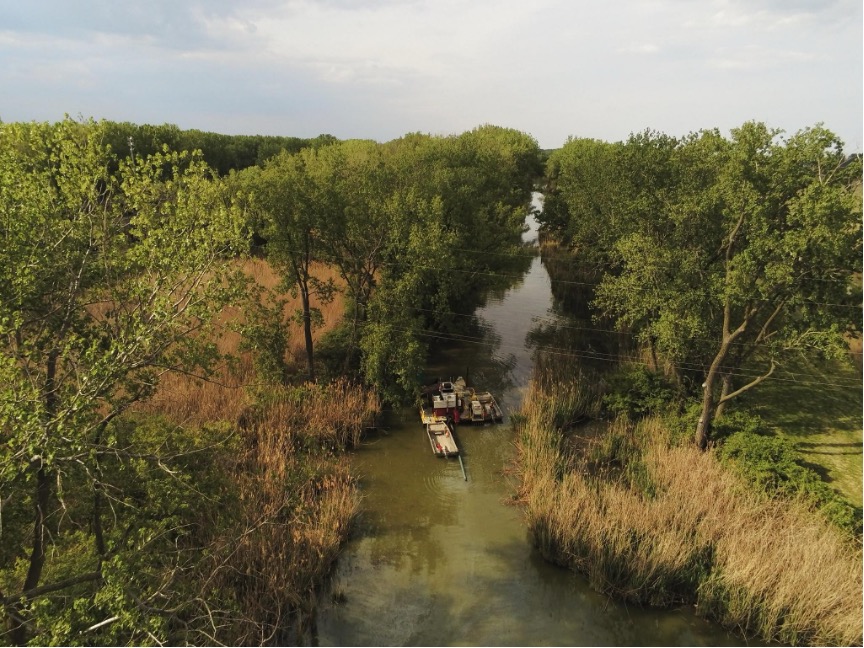
Fig. 4 Dredging operations in Otter Creek.
Photo Credit: U.S. Army Corps of Engineers
The Road to Restoration
The Impact of the GLRI
Launched in 2010, the Great Lakes Restoration Initiative (GLRI) has represented one of the most significant federal investments in large-scale ecosystem restoration within the U.S. Designed to accelerate protection and cleanup efforts across the Great Lakes region, the program has placed an emphasis on restoring Areas of Concern. Within its framework, the GLRI works as both a funding mechanism and a coordinating body, combining federal agencies, states, tribes, and local partners to address BUIs and move AOCs towards delisting. The GLRI has proven particularly effective in addressing legacy contamination in large-scale clean ups, which is often one of the most complex and costly barriers to recovery in AOCs. As a result, the GLRI has significantly accelerated the pace of restoration, with seven AOCs having been delisted and over 120 BUIs removed since the program began.
The GLRI has played a crucial role in the Maumee AOC. With more than $100 million in GLRI funding directed toward remediation and restoration efforts, a wide range of projects have been supported. within the Maumee AOC, addressing BUIs such as Degradation of Fish and Wildlife Populations, Degradation of Benthos, and Loss of Fish and Wildlife Habitat. These projects help promote a system-wide approach that can generate multiple ecological benefits rather than addressing impairments in isolation, which proves beneficial due to the AOC’s size.
The restoration of Clark and Delaware/Horseshoe Islands and the cleanup at Otter Creek show how GLRI funding has promoted highly successful interventions that address the Maumee AOC’s most persistent impairments. At the islands, investments from H2Ohio and GLRI worked together to stabilize eroding banks and install natural rock structures. Similarly, the Otter Creek project showed the GLRI’s ability to confront legacy industrial contamination at the source with sediment dredging, removing toxic pollutants, and creating the necessary conditions for recovery. Together, the projects show the importance of continued federal investment in restoration efforts that enables delisting progress.
However, the continued success of the Great Lakes Restoration Initiative depends on continued federal support. The current Congressional authorization for the program expires this fiscal year (Sept. 30, 2026); there are multiple bills in Congress that would reauthorize the program through 2031. Recent Congressional hearings have emphasized the continual challenges in the Maumee River watershed, and highlighted the effectiveness of GLRI initiatives, including wetland restoration, invasive species management, and advanced monitoring systems that help protect drinking water supplies in the region.
Lake Sturgeon
Once abundant in Lake Erie and its tributaries, the lake sturgeon has become one of the most visibly prominent indicators of both ecological collapse and recovery within the Maumee Area of Concern. Historically, sturgeon have thrived in these regional river systems, however over the past 150 years a combination of overharvesting, dam construction, and environmental degradation has led to the severe decline of its spawning populations in Ohio. Today, the reintroduction of lake sturgeon is the result of a collaborative effort to reverse this decline, and while the species’ reintroduction was not directly an AOC management action, the fish’s comeback is indicative of the restoration and water quality improvements that have resulted from AOC work. Federal and state agencies, universities, and local partners have all worked together to assess habitat conditions, evaluate long-term viability, and implement a two-decade phased reintroduction program starting in 2018. These efforts were ultimately made possible after significant improvements in water quality and habitat restoration in the Maumee River, which reestablished the conditions that could support sensitive species.
The U.S. Fish and Wildlife Service, the U.S. Geological Survey, the Ohio Department of Natural Resources, University of Toledo, Michigan State University, and the Toledo Zoo have joined forces to release approximately 3,000 young sturgeon annually with acoustic transmitters. This shows how well the lake sturgeon are doing, their activity, and if they’re surviving, which will help inform strategies for future fisheries work in the Maumee River and also build practices that can be applied across other areas of introduction in the Great Lakes region.
Dr. Bill Hintz, an associate professor at the University of Toledo and researcher at its Lake Erie Center, has helped to lead the reintroduction effort at the University. He explains how the conditions in the Maumee River can provide a model for other regional efforts. “The environmental issues that once plagued these river systems might be ameliorated to the point where the most sensitive species can thrive once again. So what we’re learning in the Maumee River can easily be applied to the Cuyahoga River and other rivers here in Ohio that are being proposed or where lake sturgeon are already being reintroduced.”
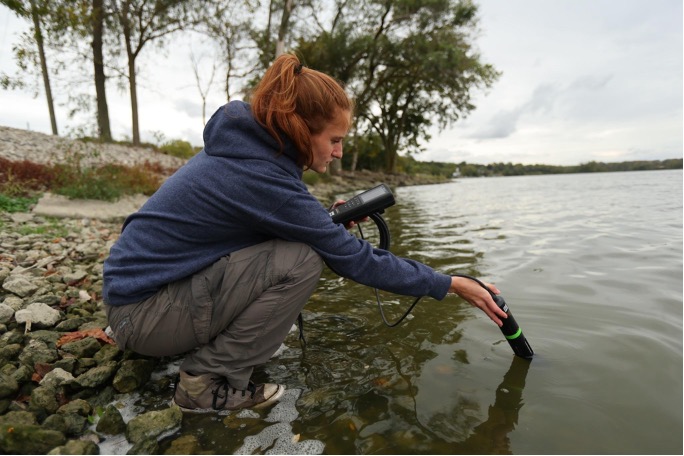
Fig. 5 University of Toledo PhD Student, Mikayla Kindler measuring
water quality in the Maumee River.
Photo Credit: Daniel Miller, University of Toledo
Lake sturgeon are a long living, bottom-dwelling fish, and they play a crucial role by feeding on benthic organisms (benthos) and invasive species such as zebra mussels and round goby. They can grow to be 6 to 8 feet in length and weigh upwards of 200 pounds over the course of their lifetime, making them the largest fish in the Great Lakes. Their sensitivity to environmental change makes them particularly vulnerable to degraded conditions. Yet their sensitivity, and role as an indicator species, is the exact thing that makes their return so significant. “Lake sturgeon are very sensitive to environmental change. So if lake sturgeon do well in the Maumee River, Northwestern Ohio, and Lake Erie, that’s probably a pretty good sign for water quality, and it’s a good sign for the state of the ecosystem,” Dr. Hintz notes.
Despite all these advancements, we are still several years away from knowing if the reintroduction has gone swimmingly. Lake sturgeon reach maturity at a slow rate: males take 15-20 years while females can take up to 20-25 years. This means that it might be decades before we see a self-sustaining population become fully established. Earlier cohorts released into the Maumee River are nearing a stage where spawning behavior might occur, but the success of this program is just beginning to be evaluated.
The return of lake sturgeon is also a rallying moment for the community. Each year, the Toledo Zoo has helped raise thousands of lake sturgeon eggs collected in the Great Lakes until they are around four months old, measuring about 6-7 inches long. Once reared to this age, the fingerlings are released into the Maumee River, with opportunities for community engagement. During ‘Sturgeon Fest’, hosted by the Toledo Zoo, visitors can release the Sturgeon directly into the river and can even sponsor a fish. This hands-on engagement is ultimately something that helps bring forward increased care and public involvement in conservation. Dr. Hintz says, “when the public can actually release a sturgeon, I think it helps integrate them into knowing they’re a part of this process. Engaging the public has been a great part of this project.”
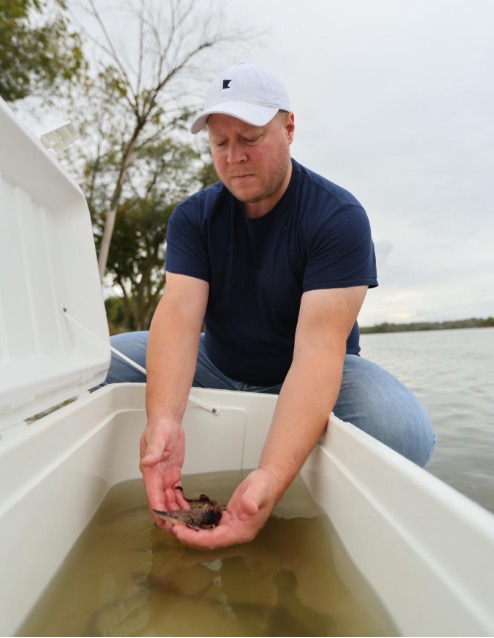
Fig. 6 Dr. Hintz handling a young Sturgeon.
Photo Credit: Daniel Miller, University of Toledo
Looking Downstream
The story of the Maumee Area of Concern is a story of decades of collaboration across institutions, programs, and communities. The progress towards delisting has required the necessary alignment of federal leadership, state implementation, and local engagement, which is shown through the efforts of the EPA, Ohio EPA, H2Ohio, and regional researchers. Combined, these groups have created a self-reinforcing structure of funding, scientific guidance, and on-the-ground action, ultimately allowing for restoration to occur on a scale that matches the AOC’s complexity and enormity.
What stands out most, however, is the tightly-knit community engaged in this work. For nearly 40 years, scientists, program managers, field staff, and local partners have all dedicated their careers to improving the Maumee AOC. Their work is often long, difficult, and deeply impactful. The efforts reflect an underlying value to restore not just the AOC itself, but a system that supports both the ecological and human community. Their desire and demonstration of a collective purpose is evident throughout their projects ranging from sediment remediation to habitat reconstruction, where progress depends as much on trust as it does on the funding.
As the Maumee AOC moves closer and closer to delisting, the challenge will ultimately lie in maintaining the momentum over these years. Restoration does not end with checking off a box; it requires persistent environmental stewardship to address emerging threats and preserve existing accomplishments. The Maumee AOC’s trajectory shows that success inherently lies in this type of collaboration, where governing bodies are engaged, communities are informed, and science continues to guide the decision-making process.