Northeast-Midwest Institute Hosts 2026 Great Lakes Environmental Summit
From left to right: NEMWI Great Lakes Program Manager Alex Eastman, Senator Gary Peters (D-MI), and NEMWI President and CEO Dr. Michael J. Goff
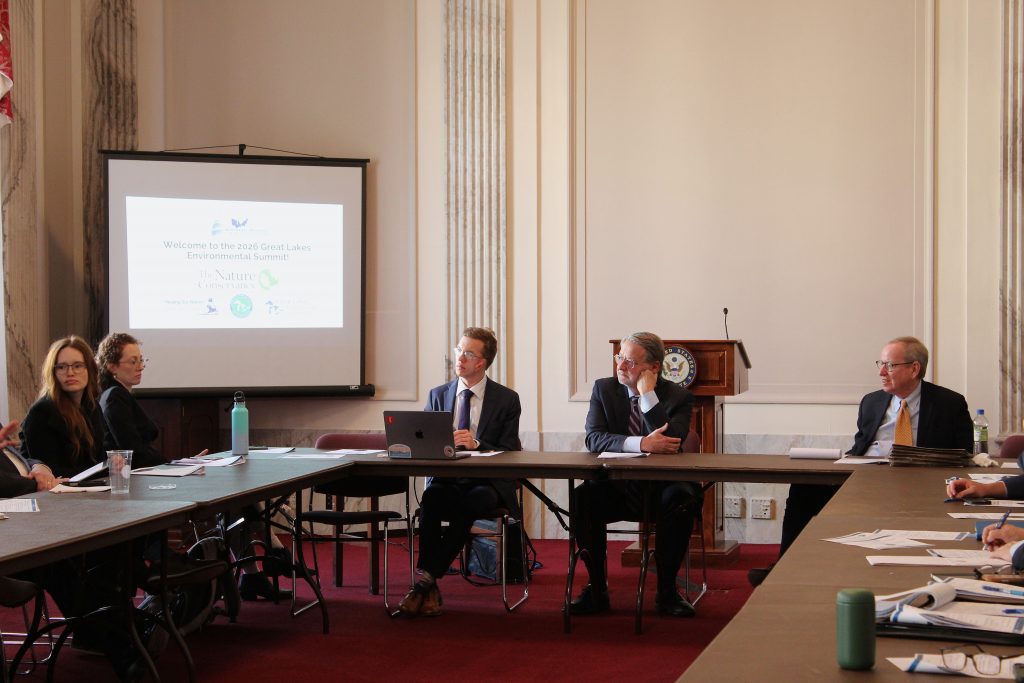
The Northeast-Midwest Institute held its annual Great Lakes Environmental Summit on Wednesday, February 11th, in Russell Senate Office Building. Held for over 30 years, the Summit serves as one of the primary convenings of policy experts, advocates, and stakeholders in Washington, D.C. to discuss the issues that are most impactful to the health of the Great Lakes.
Ellicia Sanchez, Associate Policy Director and Great Lakes Advocacy Coordinator for The Nature Conservancy in Illinois, opened the Summit with remarks on behalf of the lead sponsor of the event, The Nature Conservancy. She discussed the importance of the waters of the Great Lakes, and the role of an interconnected network of partners in protecting it. Sanchez particularly highlighted the research and management work of federal and state agencies and public servants.
NEMWI President Dr. Michael Goff expressed NEMWI’s gratitude for the support of The Nature Conservancy (TNC), which sponsored this year’s Summit, and for the support of the Healing Our Waters-Great Lakes Coalition, the Great Lakes Commission, and the Great Lakes Fishery Commission, which co-sponsored the event.
Senator Gary Peters (D-MI) and Congresswoman Debbie Dingell (D-MI) made note of crucial wins secured for the Great Lakes in 2025, including appropriated levels for key Great Lakes programs and the Great Lakes Fishery Reauthorization Act which was signed into law in December. They also stressed the importance of the binational partnership between the U.S. and Canada, both in restoring and protecting the Great Lakes, and in other arenas including trade and commerce.
Eight Congressional Committee staffers from six Committees also addressed the Summit, including Senate Appropriations Energy and Water subcommittee, Senate Environment and Public Works, House Transportation and Infrastructure, and House and Senate Agriculture. These speakers updated attendees on the GLRI reauthorization, the appropriations process, the Farm Bill, federal agency staffing, and other critical topics. The Summit concluded with a roundtable discussion.
The Nature Conservancy helps advance conservation across six continents, including in more than 80 countries and territories and all 50 U.S. states. And, for more than 65 years, The Nature Conservancy has helped protect and restore millions of acres of lands and waters throughout the Great Lakes. Guided by science and leveraging decades of on-the-ground experience, they collaborate with countless public and private sector partners to scale innovative solutions for the biggest conservation challenges, ensuring both people and nature can thrive.
Since 2004, the Healing Our Waters-Great Lakes Coalition has been harnessing the collective power of more than 200 groups representing millions of people, whose common goal is to restore and protect the Great Lakes. Learn more at HealthyLakes.org or follow on social media @HealthyLakes.
The Great Lakes Commission, an intergovernmental agency established in 1955, recommends policies and practices to balance the use, development, and conservation of the water resources of the Great Lakes and brings the region together to work on issues that no single community, state, province, or nation can tackle alone.
The Great Lakes Fishery Commission is a binational organization established via treaty between Canada and the United States in 1955 to advance freshwater science, promote cross-border collaborations, and to control invasive seal lamprey in the Great Lakes. Together with our partners, the Commission works to support a healthy and sustainable Great Lakes ecosystem through a voluntary, collaborative, science-based approach that has been delivering positive results for decades.